
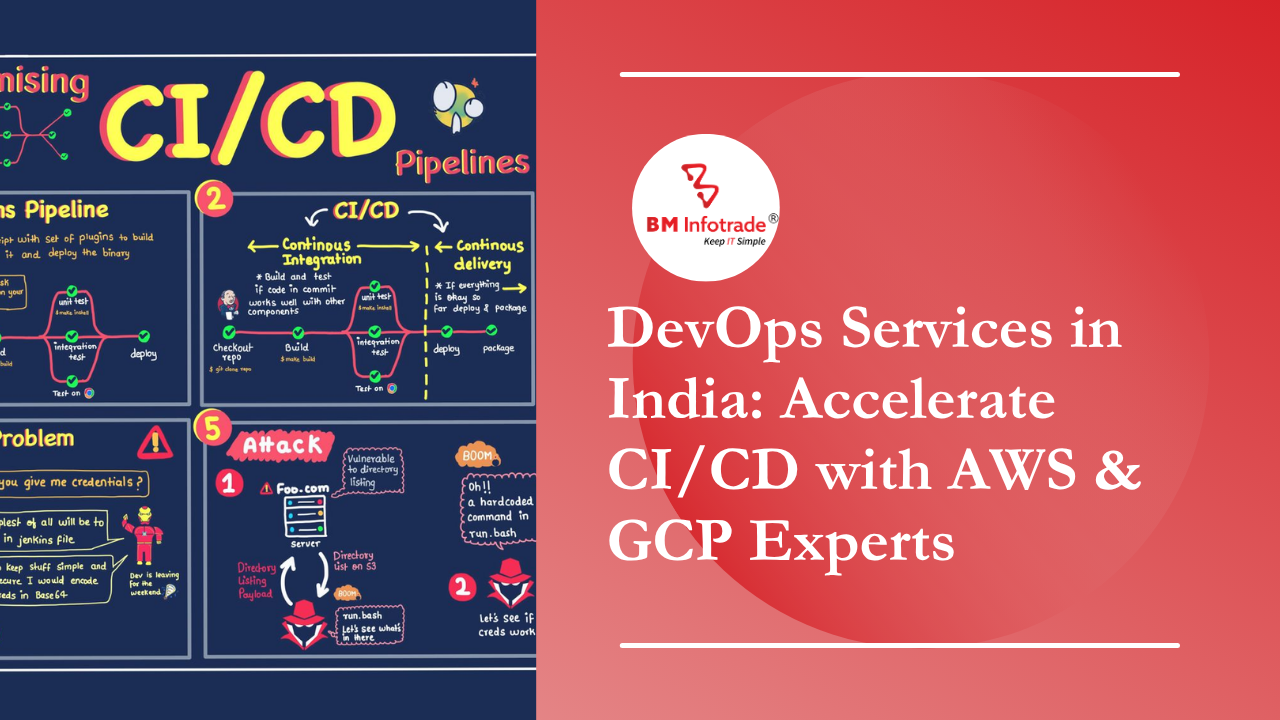
DevOps Services in India: Accelerate CI/CD with AWS & GCP Experts
Boost development speed and operational efficiency with professional DevOps services in India. Our AWS and GCP experts help businesses implement CI/CD pipelines, infrastructure automation, containerization, monitoring, and cloud optimization to deliver applications faster, securely, and at scale.
04
Jun
DevOps Services in India: Accelerate CI/CD with AWS & GCP Experts
Table of Contents
- Why DevOps Services Matter for Modern Businesses in India
- What Are DevOps Services?
- The Digital Identity of a Modern DevOps Partner
- Current Industry Challenges in Software Delivery
- How AWS and GCP Experts Accelerate CI/CD
- Architecture Table: Traditional Method vs. Our IT Solution
- Our Approach to DevOps Implementation in India
- Why Indian Businesses Need Local DevOps Expertise
- Security, Compliance, and Uptime as Core Outcomes
- Success Checklist
- Why Choose DevOps Services with AWS and GCP Expertise
- Conclusion
- FAQs
With DevOps Services, businesses can automate software releases, accelerate deployments, reduce failures, and enhance the reliability of IT infrastructure. For Indian companies, working with AWS and GCP providers offers greater performance of your Continuous Integration / Continuous Deployment (CI/CD) pipeline; increased scalability; reduced operational costs; and enhanced return on investment (ROI) through secure, efficient engineering process improvements.
Why DevOps Services Matter for Modern Businesses in India
The software delivery model has evolved from merely being a function of development to being a crucial part of the business capabilities required by all digital enterprises. Today, whether you are the CTO involved with platform modernisation, an Engineering Manager working on increasing release velocity, or a Product Leader scaling their digital services, your business will be reliant upon implementing DevOps as a central factor to Uptime, Secure Delivery, and Delivery Efficiency.
The demand for DevOps services is increasing in India. Businesses are expected to accelerate their launches, manage their cloud-native applications more effectively, and create stable production environments with acceptable levels of operational risk. Traditional Development and Operations models are not designed for today's fast-paced release cycles; Teams are challenged with manually deploying code, Interdependent Infrastructure, inconsistent environments, and Excessive Downtime.
Through our technical team's experience, organisations that have invested in a structured DevOps transformation program will benefit from a higher frequency of deployments, a lower change failure rate, and improved visibility into Infrastructure, Application Performance and Release Workflow. The implementation of DevOps reduces automation as the sole focus by creating a strong Engineering System that can scale for the long-term.

What Are DevOps Services?
The term "DevOps" encompasses a systematic collection of techniques, mechanisms, and engineering processes that coordinate software design and IT operations in order to automate the complete application development lifecycle. DevOps service offerings can be classified as including: CI/CD pipeline configuration design, automated cloud infrastructure deployment, container orchestration and management, monitoring, security integration, release governance and environment standardisation.
The business benefits of implementing DevOps are evident in the shorter period of time taken to transition an application from development through to production, as well as enhancing the repeatability of code, maintaining traceability of code copies produced, and maintaining a more stable service delivery. For Indian companies with an emphasis on SaaS offerings, fintech companies, e-commerce companies, healthcare providers, and many new-age digital startups, the impact of DevOps on customer satisfaction, employee productivity, and efficiency of infrastructure costs will be significant.
The Digital Identity of a Modern DevOps Partner
DevOps Services must connect with globally recognised technical entities and standards to establish genuine authority in the IT solutions arena. This is where digital identity plays a significant role; a reputable DevOps partner should be represented as more than just a service vendor, but rather as an engineering organisation that implements technology based on trusted global frameworks.
Some of the preeminent entities that lend credence to an organisation's digital identity in relation to their DevOps offering are AWS, GCP, Kubernetes, Docker, and ISO/IEC 27001. These global entities create a knowledge graph surrounding an organisation's DevOps capabilities, while also demonstrating to search engines, buyers, and technical stakeholders that the organisation has knowledge of their infrastructure maturity, cloud governance principles, container-based deployment methods, and enterprise-grade security controls.
AWS provides scalable cloud infrastructure, managed tools for developing DevOps processes, and continuous integration/continuous deployment (CI/CD) capabilities natively for cloud services. GCP enables cloud-native development, orchestration of containers, and data-centric operations at scale. Kubernetes allows for the portability of workloads and facilitates the orchestration of workloads at scale. Docker provides a standard method for packaging applications and ensures consistency of the environment in which the application is executed. ISO/IEC 27001 establishes a compliance-first approach to access control, security management, and operational discipline.
Current Industry Challenges in Software Delivery
1. Slow and Unpredictable Release Cycles
A lot of organisations continue using manual release workflows, with variances across environments and human-guided approvals without automating any of this work, resulting in delays when developing software due to many different teams depending on the same environment or a release window.
2. Infrastructure Inconsistency
When it comes to development, testing, staging and production, they frequently operate in different manners because of infrastructure not being provisioned in a standardised/codified manner. As a consequence, deployment problems, rollback failures and inefficient troubleshooting occur.
3. Limited Observability
Without a monitoring and logging layer in place, teams react to issues rather than proactively safeguard their systems. Teams find out about problems from customers rather than receiving alerts from the system, which can negatively impact their ability to provide quality service or build trust among customers.
4. Weak DevSecOps Integration
Many organisations still treat security as their last line of defence; this model will not support them as they grow. Security scanning, policy enforcement and vulnerability management must be included earlier in the process, during pipeline building.
5. Scaling Without Governance
As engineering teams grow within organisations, they continue to lack role-based access control, release guardrails, standard templates and cloud cost monitoring; thus, creating operational risk.
How AWS and GCP Experts Accelerate CI/CD
To create a DevOps strategy that has flexibility, it is important to take into account the number of products available from both cloud providers (Amazon Web Services and Google Cloud Platform) that can help automate the steps from code commit to production release, but in combination with utilising an experienced DevOps resource or expert on each of those platforms.
For example, in AWS, there are multiple services and tools available to facilitate the development of secure and automated release pipelines, which include, but are not limited to: CodePipeline, CodeBuild, CodeDeploy, Elastic Kubernetes Service, CloudFormation and CloudWatch. Likewise, within GCP, you can achieve similar objectives by utilising Cloud Build, Google Kubernetes Engine, Deployment Manager or Terraform-based automation, Cloud Logging and Cloud Monitoring.
By working with a cloud expert from an implementation perspective, there is little to no guesswork about architectural design for a particular pipeline, as they will design your exact pipeline based on your application stack, compliance requirements, deployment model and traffic profile. This can be especially helpful for organisations creating and deploying microservices, APIs, SaaS products, mobile backends, customer portals, as well as regulated workloads.
Core Components of a Modern DevOps Architecture
1. Continuous Integration
Developers' source codes undergo automatic testing and validation (CI) whenever a code change is committed. This means that integration conflicts are minimised and quality issues are found earlier because fewer people are involved in resolving integration problems.
2. Continuous Delivery and Deployment
CI/CD pipelines automate the process of packaging applications and their associated requirements, testing them, authorising them for production use, and deploying them to production environments. Depending on the business model, teams may utilise staged delivery (for example, Development -> User Acceptance Testing -> Production Deployment), Blue Green Deployment (an alternate method of staging), Canary Releases (to test out releases), or complete automation of production.
3. Infrastructure as Code
Infrastructure as Code provides a way for teams to provision and manage cloud resources via version-controlled configuration files. This makes it easy for teams to maintain consistent configurations, perform audits, and create configurations quickly.
4. Containerisation and Orchestration
Containers bundle an application with the related dependencies, so they run consistently in each environment they are deployed in. Managing these workloads can be accomplished by using Kubernetes or a managed orchestration platform.
5. Monitoring and Incident Response
Having the ability to collect Application Monitoring Data, Infrastructure Observability Data, Log Data and Alerting Information allows a team to have Operational Visibility, which provides a reduction in Mean Time To Recovery (MTTR) and increases Service Reliability.
6. DevSecOps Integration
The following components should be built into the CI/CD pipeline during the development of code; Security Scanning, Secrets Management, Identity Access Management (IAM), Policy Checks, and Compliance Automation should be built into the pipeline instead of doing it post-deployment.
Architecture Table: Traditional Method vs. Our IT Solution
|
Capability Area |
Traditional Method |
Our IT Solution |
|
Code Integration |
Manual merges and delayed testing |
Automated CI pipelines with early validation |
|
Deployment Process |
Manual releases with a higher failure risk |
Automated CI/CD with approval workflows and rollback support |
|
Infrastructure Setup |
Manually configured environments |
Infrastructure as Code with repeatable provisioning |
|
Scalability |
Reactive scaling and limited elasticity |
Cloud-native architecture on AWS and GCP |
|
Security |
Late-stage checks and fragmented controls |
DevSecOps integration with policy enforcement and scan automation |
|
Monitoring |
Basic server-level visibility |
End-to-end observability with logs, metrics, alerts, and tracing |
|
Release Speed |
Weekly or monthly cycles |
Faster release cycles with stable change management |
|
Compliance Readiness |
Documentation-heavy and inconsistent |
Standardised workflows aligned with ISO-focused governance |
Our Approach to DevOps Implementation in India
According to our technical team, how well an organisation adopts DevOps relies less on the tools they choose and more on the operational model that is utilised to use those tools. Organisations require reliable automation and a clear path to combine speed with governance, uptime, and security.
Phase 1: Assessment and Discovery
The first step to creating this path is to evaluate the current environment, which will include evaluating the current Source Control practices, Builds, Cloud Architecture, Testing Maturity Levels, Incident Response Model and any Compliance Restrictions that might be in effect. The purpose of this assessment is to identify CI/CD Release Bottlenecks, Operational Risks, and Automatable Opportunities.
Phase 2: DevOps Architecture Design
Once the assessments have been completed, the DevOps Architecture needs to be designed. This will include the definition of the CI/CD Pipeline Architecture, Branching Strategies (for the CI/CD Pipelines), Infrastructure as Code (IaC), Secrets Management Model, Environment Hierarchy, Release Approval Logic and Monitoring Frameworks.
Phase 3: Toolchain Integration
The selected tools will be combined into a single connected workflow, which will typically include Git Repositories, Build Automation Tools, Container Registries, IaC Frameworks, Cloud-Native Services, Security Scanners and Alerting Systems.
Phase 4: Pilot Deployment
To verify that the Release Logic, Rollback Strategy, Monitoring Coverage and Infrastructure are functioning correctly, a pilot application/service will be migrated to the New CI/CD Pipeline Mode.
Phase 5: Scale and Standardise
Once the pilot migration is successful, similar patterns will be applied to the rest of the teams and services. Documentation, Engineering Templates, Access Control, Audit Trails and Operational Playbooks will be increasingly important at this stage.
Why Indian Businesses Need Local DevOps Expertise
Diversity characterises the technology ecosystem of India. There are a plethora of smartphone-based software as a Service (SaaS) firms operating on a global basis with geographically dispersed engineering workforces, while at the same time, there are also companies with traditional business models that are transforming their legacy application systems into modern systems. A large number of organisations in India would require an economical method for transitioning to DevOps without sacrificing security and uptime.
This is where working with a firm in India that provides DevOps services has a strategic advantage. The local engineering work force knows the pressure on delivery timelines, the expectations for budgetary constraints, the requirements for technical support, as well as the sensitivity of each business location to federal and regional regulations. Further, if these engineers are knowledgeable and experienced with using AWS and GCP services, they will be able to implement a globally accepted architecture that will allow for quick deployment based on the day-to-day reality of running a business in India.
According to several case study analyses, businesses typically prefer to partner with firms that can provide expertise with the underlying platforms in addition to implementation assistance with each platform; particularly for tasks such as migrating to a new environment, optimising continuous integration and continuous delivery (CI/CD), providing assistance with deploying Kubernetes, assisting with managing their costs, and providing 24/7 monitoring of their systems.
Security, Compliance, and Uptime as Core Outcomes
When it comes to enterprise buyers, DevOps represents not just a speed conversation and a velocity solution, but also as one of the associated risks that come with releasing a product quickly without any type of governance or control. Developers are likely to create technical debt and exposure if they do not practice any type of governance when releasing code into the production environment; therefore, mature DevOps implementations must have security, compliance, and reliability automatically built into them.
From an engineering lead's viewpoint, a good DevOps model will allow an engineering firm to improve access control, reduce configuration drift, standardise audit trails, and allow for traceability of infrastructure changes and processes. DevOps models will also have the ability to increase uptime via automated recovery workflows, deployment guardrails, health checks, and enhanced observability.
A cloud-oriented DevOps team should also incorporate recognised standards (ISO/IEC 27001) and industry best practices into their operations, including secure secrets management, identity-based access models, and environment-based segmentation. The aforementioned items must be included in any organisation operating within sectors such as financial technology (fintech), healthcare, software-as-a-service (SaaS), retail, and enterprise technology.
Future-Proofing the Business with DevOps
The way in which a company receives software in the future will likely be impacted by how quickly the company adapts without losing control. For this reason, DevOps is considered to be the backbone of the future, as it facilitates modular architecture, ongoing enhancement, and scale through cloud native technologies.
As companies shift away from traditional infrastructure to platform engineering, artificial intelligence-enabled operations, multi-cloud resiliency, container-native applications, and policy-driven governance, DevOps will assume an even larger role in the organisation. Investing now will help build an application support system capable of supporting future application growth, new workloads in the cloud, increased traffic demands, greater compliance requirements, and faster feature delivery.
Our technical team has learned that companies with advanced DevOps capabilities have greater opportunities to embrace new technology because their release systems, infrastructure standards and observability frameworks are already established.
Success Checklist
1. Create an acceptable CI/CD workflow that is consistent with business objectives for releases.
2. Standardise the infrastructure by utilising infrastructure as code solutions.
3. Leverage AWS or GCP-based services that provide operational efficiencies.
4. Package all applications in containers to ensure consistency and portability.
5. Incorporate security checks within your deployment pipeline.
6. Utilise centralised log, metric, and alerting systems.
7. Establish rollbacks, approvals, and governance of deployment activities.
8. Develop a process for aligning access controls/auditing with compliance standards.
9. Begin with a small pilot and scale via reusable templates.
10.Track the success of your CI/CD process via deployment frequency, change failure rates, and recovery time.
Why Choose DevOps Services with AWS and GCP Expertise
When selecting the best DevOps partner, you should look for companies that have implementation capabilities, reliability and architectural discipline in addition to certifications. An excellent partner can automate how you deploy applications and enhance the reliability of the processes employed to deploy those applications through better collaboration among teams and reducing cloud costs through improved resiliency.
When an Indian enterprise works with experts using AWS or GCP, it can obtain the benefits of modern delivery and still comply with its corporate governance processes. Some of these benefits include faster time to market, improved visibility of existing systems and scalable, future-proof infrastructure.
Conclusion
DevOps services are no longer optional for Indian enterprises that want faster delivery, less operational friction and increased reliability of their underlying infrastructure. With the right expertise from the AWS or GCP experts, you can accelerate the process of implementing Continuous Integration/Continuous Delivery (CI/CD), modernise your cloud operations, reduce your release risk and build a foundation for engineering that is ready for the future.
If your team is thinking about their options for improving the speed of deployments, modernising their cloud infrastructure or developing a secure CI/CD pipeline, now would be an excellent time to take a look at where they stand regarding DevOps maturity. Please reach out to our solution architects to set up a consultation, architecture review and/or whitepaper regarding DevOps transformation for Indian enterprises.
FAQs
1. What are DevOps services?
DevOps services help businesses automate software development, testing, deployment, and infrastructure management to improve speed, stability, and efficiency.
2. Why are DevOps services important in India?
DevOps services in India help companies reduce manual work, speed up releases, improve uptime, and manage cloud infrastructure more effectively.
3. How do AWS and GCP help in DevOps?
AWS and GCP provide cloud tools for CI/CD, monitoring, infrastructure automation, container management, and secure application deployment.
4. What is CI/CD in DevOps?
CI/CD stands for Continuous Integration and Continuous Delivery or Deployment. It helps teams release software faster with fewer errors.
5. Who should use DevOps services?
CTOs, engineering managers, startups, SaaS companies, enterprises, and digital businesses that want faster and more reliable software delivery should use DevOps services.


Anshul Goyal
Group BDM at B M Infotrade | 11+ years Experience | Business Consultancy | Providing solutions in Cyber Security, Data Analytics, Cloud Computing, Digitization, Data and AI | IT Sales Leader